What can a digital smile design predict, and what can it not?
A digital smile design is reliable for what it was built to do: show the proposed shape, length and proportions of the teeth on your own face, and give you, the dentist and the laboratory one picture to discuss. It is a plan, not a promise. Three things lie outside what the simulation can foresee: how the gums will heal, how the shade will look in real light, and how the new teeth will behave when you bite and chew. Those are settled by steps that come after the screen.
What are the benefits of smile design software?
A recent systematic review (Alwabel et al., 2025) pooled seven studies and found that digitally designed treatment was associated with higher patient satisfaction, better treatment acceptance and better communication than conventional planning. The authors add that the evidence is limited by small samples and by differences in how the studies were designed.
A narrative review in the Saudi Dental Journal (Alharkan, 2024) puts the central idea simply: the design lets patients visualise the likely outcome before treatment starts and take part in the decision, which matters because some cosmetic procedures are irreversible. The main digital smile design benefits, in other words, are clarity and shared decision-making, not certainty.
Limit one: a flat photograph of a three-dimensional mouth
Most simulations begin with a photograph of the face, and a photograph has two dimensions. A study of 30 patients (Ortensi et al., 2022) compared measurements in the two-dimensional design with those in a three-dimensional plan built from scans of the teeth. Most measurements differed significantly; only the height of the incisors agreed. Even so, the finished veneers were clinically adequate and close to both plans.
For a patient this means the image is a good approximation of the overall look, not a measurement to the millimetre. Camera angle, head tilt and lens all change the apparent width of the teeth towards the sides of the smile.
Limit two: gums heal in their own way
When the plan includes reshaping the gum line or lengthening the teeth, the software draws the new gum margin as a fixed line. Real gum is living tissue that moves after surgery. A 12-month study of surgical crown lengthening (Pontoriero and Carnevale, 2001) found that the gum margin crept back towards the crown of the tooth by about 3 mm on average during the year, more so in patients with thick gum tissue, and with individual variation in healing.
That study concerned restorative crown lengthening with bone reshaping, not every type of cosmetic gum procedure, so the figure does not transfer to every case. The principle does: the final gum level is known only after healing, which is why final restorations wait until the gums are stable. Gum surgery is carried out by a specialist.
Limit three: shade on a screen is not shade in daylight
A screen is lit from behind; a tooth reflects whatever light falls on it. A shade that looks right in the presentation can appear lighter or cooler outdoors and warmer under indoor lighting.
For that reason the shade is never chosen from the screen. It is selected with physical shade tabs held beside your teeth under more than one light source, and checked again at the try-in before bonding.
Limit four: the bite does not show in a smile photograph
The picture shows your teeth while you smile. It does not show how upper and lower teeth meet when you bite, or when the jaw slides forwards and sideways. Adding a millimetre of length looks minor on screen, yet in the mouth it may collide with the lower teeth or alter certain speech sounds.
This can only be tested on models of the teeth, digital or printed, and then in the mouth.
Other digital smile design limitations
A design is only as good as the records behind it, and a tilted photograph produces a tilted design. A photograph is a single frozen moment, whereas a smile and speech are movement. Some programmes suggest stock tooth shapes that end up looking alike unless the clinician adapts them to the face.
The most serious limitation is not in the software but in how it is presented. When the image is shown as the certain result, expectations rise above what ceramics and gums can deliver.
How does a simulation become a result you recognise?
Three steps close the gap. A mock-up transfers the design to your mouth without any drilling, so you see it on your face and speak with it. Where teeth are prepared, provisional restorations in the same shape are worn for a period, and they are the real test of bite and speech. And where surgery is involved, the gums are left to settle before the final work is made.
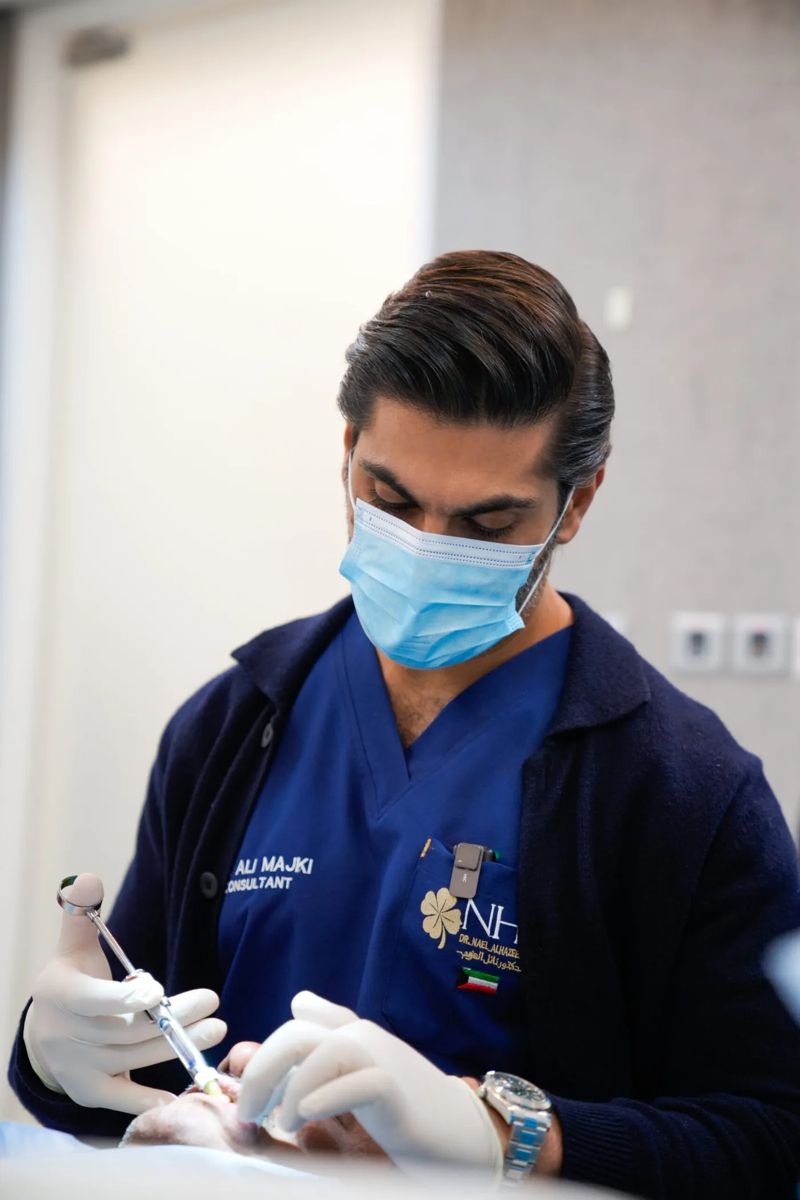
This is the sequence Dr. Ali Majki, consultant in comprehensive and cosmetic dentistry, follows at Aline Dental in Shaab: the screen opens the discussion, the trial in the mouth settles it, and any change you ask for is made before the final ceramic is produced.
Scientific sources
Alwabel L.K. et al. Digital Smile Design and patient-centered outcomes in esthetic restorative dentistry: a systematic review. Cureus, 2025;17(11):e98084. doi:10.7759/cureus.98084
Alharkan H.M. Integrating digital smile design into restorative dentistry: a narrative review of the applications and benefits. Saudi Dental Journal, 2024;36(4):561-567. doi:10.1016/j.sdentj.2023.12.014
Ortensi L., Sigari G., La Rosa G.R.M., Ferri A., Grande F., Pedullà E. Digital planning of composite customized veneers using Digital Smile Design: evaluation of its accuracy and manufacturing. Clinical and Experimental Dental Research, 2022;8(2):537-543. doi:10.1002/cre2.570
Pontoriero R., Carnevale G. Surgical crown lengthening: a 12-month clinical wound healing study. Journal of Periodontology, 2001;72(7):841-848. doi:10.1902/jop.2001.72.7.841
Frequently asked questions
Will my final smile look exactly like the design? Close in overall shape when the design has been tested in the mouth, but not an exact copy. Gums, shade and bite are factors the screen does not control.
What are the benefits of digital smile design if it is not a promise? You see the direction before any tooth is touched, you can ask for changes, and the laboratory has a clear reference. That reduces surprises; it does not remove them.
Is digital smile design accurate for choosing a shade? No. A screen cannot reproduce the colour of real ceramic, so the shade is chosen with physical tabs under different lighting.
Can I ask for changes after seeing the design? Yes, and that is the purpose of it. The design and mock-up stage is the easiest time to change anything; after the ceramic is bonded it is the hardest.
Where can I have a digital smile design in Kuwait? Dr. Ali Majki sees patients at Aline Dental in Shaab, Kuwait; patients come to him from across Kuwait — from Jahra to Al-Rai and The Avenues — and from Doha and Qatar.