Feldspathic or E.max veneers: the short answer
Feldspathic veneers are built up by hand from porcelain powder, layer by layer, which gives the ceramist the finest control over colour and translucency. E.max veneers are pressed or milled from lithium disilicate, a reinforced glass-ceramic that is considerably stronger and more forgiving in daily use. Long-term survival is high for both; the evidence points to fewer complications with lithium disilicate.
So the emax vs feldspathic question is rarely about which is “better”. It is about which suits your teeth, your bite and the change you want.
What are feldspathic porcelain veneers?
Feldspathic porcelain is the original veneer ceramic, a glass-based material. Feldspathic porcelain veneers are made by a dental ceramist who mixes porcelain powders with liquid and paints them onto a heat-resistant model of your tooth (a refractory die) or onto platinum foil, firing the work between layers. This is why they are also called hand layered veneers.
Because every layer can carry a different shade and opacity, the ceramist can copy the small details of a natural tooth: a translucent edge, a warmer neck, faint internal character. The price of that artistry is dependence on the individual ceramist and a material with relatively low strength until it is bonded to enamel.
What are E.max veneers?
E.max is a brand of lithium disilicate, a glass-ceramic filled with interlocking crystals. The veneer is either pressed from a heated ingot into a mould or milled from a block by CAD/CAM, then stained and glazed, and sometimes finished with a thin hand-layered surface.
The crystals are what make the difference mechanically. A narrative review of the material (Zarone et al., 2019) reports a flexural strength of 370 to 460 MPa for pressed lithium disilicate, described as much higher than the older glass-ceramics. People searching for porcelain veneers, or “porcelin veneers” as it is often typed, are in practice usually offered one of these two materials.
Which looks more natural?
In skilled hands both can be indistinguishable from enamel. Feldspathic porcelain has the edge where the finest optical detail matters, for example one or two veneers that must match untouched neighbouring teeth exactly.
E.max comes in several translucencies and opacities, which helps in a different situation: a darker tooth. A more opaque ingot can mask discolouration that a very translucent layered veneer would let through. For a full set of veneers in a bright, even shade, most people could not tell the two materials apart.
How thin can they be, and how much tooth is removed?
Both materials can be made very thin, and both are at their best bonded to enamel. Feldspathic porcelain can be feathered out to a very fine edge, which suits additive, minimal-preparation cases. Lithium disilicate keeps useful strength at reduced thickness, so it is also used for conservative designs.
What decides the amount of preparation is not mainly the brand of ceramic. It is the position and colour of your teeth and the shape you are aiming for. Teeth that sit forward or are very dark need more room; teeth that are small or set back may need little or none. In the long-term feldspathic study quoted below, the preparations were kept at least 80% within enamel.
Which is stronger and lasts longer?
A systematic review and meta-analysis of 29 clinical studies (Klein et al., 2025) pooled veneer survival at 10.4 years as 96.13% for feldspathic and 96.81% for lithium disilicate, with no significant difference between materials. The gap appeared in complications: long-term technical complications such as cracks, chips and debonding were pooled at 41.48% for feldspathic veneers against 6.1% for lithium disilicate.
An earlier meta-analysis of 13 studies (Morimoto et al., 2016) estimated survival at 94% for glass-ceramic and 87% for feldspathic veneers over a median of nine years, although its own analysis found that the type of ceramic did not significantly influence the failure rate.
Feldspathic veneers can nevertheless last a very long time under the right conditions. In a single-clinician series of 499 veneers followed for up to 21 years (Layton and Walton, 2012), estimated survival for the whole sample was 96% at 10 years and 91% at 20 years, with the veneers bonded to prepared enamel.
Who suits which material?
Feldspathic tends to suit patients with healthy, light-coloured enamel, a stable bite and a small number of front teeth where an exact match is the priority, and where little or no preparation is planned.
E.max tends to suit larger smile makeovers, darker teeth that need masking, teeth with existing fillings, and patients whose bite or habits put more load on the edges. Heavy grinding has to be managed with either material, usually with a night guard after treatment.
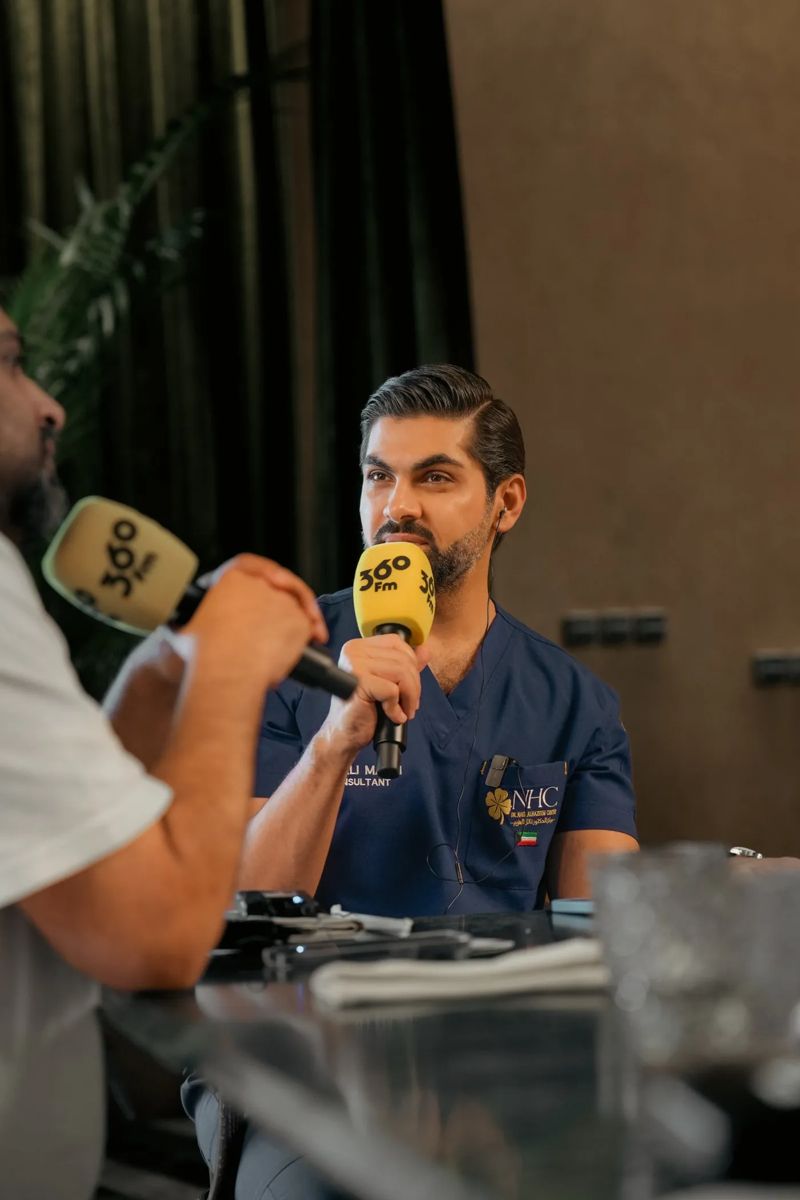
At Aline Dental in Shaab, Dr. Ali Majki, Consultant in Comprehensive & Cosmetic Dentistry, chooses between them after an examination, photographs and a trial of the planned shape on the teeth, so the decision rests on what the case needs rather than on a material’s name.
What matters more than the material?
Three things. Bonding to enamel: veneers bonded mostly to enamel perform better than those bonded to exposed dentine. Design and trial: seeing and approving the shape before any preparation. And maintenance: cleaning between the teeth, regular reviews and protection from grinding. A well-planned veneer in either ceramic will outlast a poorly planned one in the “stronger” material.
Scientific sources
Klein P., Spitznagel F.A., Zembic A., Prott L.S., Pieralli S., Bongaerts B., Metzendorf M.I., Langner R., Gierthmuehlen P.C. Survival and Complication Rates of Feldspathic, Leucite-Reinforced, Lithium Disilicate and Zirconia Ceramic Laminate Veneers: A Systematic Review and Meta-Analysis. Journal of Esthetic and Restorative Dentistry, 2025. doi:10.1111/jerd.13351
Morimoto S., Albanesi R.B., Sesma N., Agra C.M., Braga M.M. Main Clinical Outcomes of Feldspathic Porcelain and Glass-Ceramic Laminate Veneers: A Systematic Review and Meta-Analysis of Survival and Complication Rates. International Journal of Prosthodontics, 2016. doi:10.11607/ijp.4315
Layton D.M., Walton T.R. The up to 21-year clinical outcome and survival of feldspathic porcelain veneers: accounting for clustering. International Journal of Prosthodontics, 2012;25(6):604-12. PMID 23101040
Zarone F., Di Mauro M.I., Ausiello P., Ruggiero G., Sorrentino R. Current status on lithium disilicate and zirconia: a narrative review. BMC Oral Health, 2019. doi:10.1186/s12903-019-0838-x
Frequently asked questions
Are feldspathic veneers better than E.max? Neither is better in every case. Feldspathic offers the finest hand-made detail; E.max offers more strength and fewer long-term complications. The case decides.
Do feldspathic veneers break easily? They are more fragile before bonding and showed more chips and cracks in long-term studies, but when bonded to enamel their survival over ten years and more is high.
Can E.max veneers look as natural as hand layered veneers? Yes, in most situations, particularly when the surface is individually stained or finished with a thin layered porcelain.
Which veneer is thinner? Both can be made very thin. The thickness you need depends mainly on the colour and position of your teeth, not on the brand of ceramic.
Which is better for dark teeth? Usually lithium disilicate, because more opaque versions can mask the underlying colour without a thick veneer.
Where can I get feldspathic or E.max veneers in Kuwait? Dr. Ali Majki sees patients at Aline Dental in Shaab, Kuwait; patients come to him from across Kuwait — from Jahra to Al-Rai and The Avenues — and from Doha and Qatar.