Is a Hollywood smile worth it? The short answer
A Hollywood smile, meaning a set of porcelain veneers on the teeth that show, gives a large and stable change in colour and shape within a few visits. In return it is usually irreversible, it needs lifelong care, and it is not for life: at some point the veneers will be remade. It is worth it when the real problem is the shape and colour of the teeth, the enamel is sound, and you understand the commitment.
What are the real advantages?
Stable colour: glazed ceramic does not pick up stain the way enamel and fillings do, so the shade you choose stays. Controlled shape: length, width and symmetry are designed digitally and tried in your mouth before anything is final. Speed: a change that would take months with aligners and whitening is reached in weeks.
One advantage is often overlooked: veneers are far kinder to the tooth than full crowns. A laboratory study on model teeth (Edelhoff and Sorensen, 2002) weighed how much tooth each preparation removes. Veneer preparations removed roughly 3% to 30% of the crown of the tooth by weight; full crown preparations removed about 63% to 72%. If your Hollywood smile teeth are being veneered and not crowned, you are on the conservative side of that comparison.
Disadvantage one: can it be reversed?
Usually not. Most cases need a thin layer of enamel removed so that the veneer does not look bulky, and enamel does not grow back. A tooth prepared for a veneer will need a covering for the rest of its life. Of all the Hollywood smile disadvantages people ask about, this is the most important: not harm in the sense of disease, but a permanent commitment.
Disadvantage two: how long before it needs redoing?
A meta-analysis of 13 clinical studies (Morimoto et al., 2016) estimated overall survival of porcelain veneers at 89% over a median follow-up of nine years, with fracture or chipping the most frequent complication. A study from Innsbruck Medical University that followed 318 veneers for up to twenty years (Beier et al., 2012) estimated survival at 94.4% after five years, 93.5% at ten and 82.93% at twenty.
Those are good figures, but read them from the other side: roughly one veneer in six needed replacing within twenty years. Someone who has the treatment at thirty will live with veneers for decades, so at least one cycle of replacement should be expected, and each replacement means further work on the tooth, however slight. That belongs in the decision from the start.
Disadvantage three: what upkeep does it demand?
The same Innsbruck study found a 7.7-times greater risk of failure in patients with bruxism, a higher risk on non-vital teeth, and more discolouration at the margins in smokers. Anyone who grinds needs a night guard for good, and a smoker should expect the edges to darken with time.
Veneers do not excuse you from cleaning: the tooth beneath can still decay, and the gum becomes inflamed if deposits build up at the margin.
What separates a result that lasts from one you regret?
Enamel. A retrospective study of 580 veneers followed for up to twelve years (Gurel et al., 2013) found that veneers bonded to dentine, that is, after preparation that went through the enamel, were about ten times more likely to fail than veneers bonded to enamel. Survival was 99% for veneers whose preparation stayed entirely within enamel.
In practical terms, a small and measured preparation gives a stronger bond and a longer life. Heavy preparation, which happens when work is done without a design or when sound teeth are crowned without need, lies behind most of the bad stories told about the Hollywood smile.

Who should consider something else?
If colour is the only complaint and the shape is fine, whitening is enough and leaves the tooth intact. If the issue is crowding or spacing, clear aligners move the teeth instead of covering them. If there is one small chip or a single gap, composite bonding is simpler and needs little or no preparation.
What should you ask before you agree?
How much will be removed from each tooth, and will the preparation stay in enamel? Will I see the design and try it in my mouth before any preparation? Veneers or crowns, and why? What happens if a veneer breaks years later? Will I need a night guard?
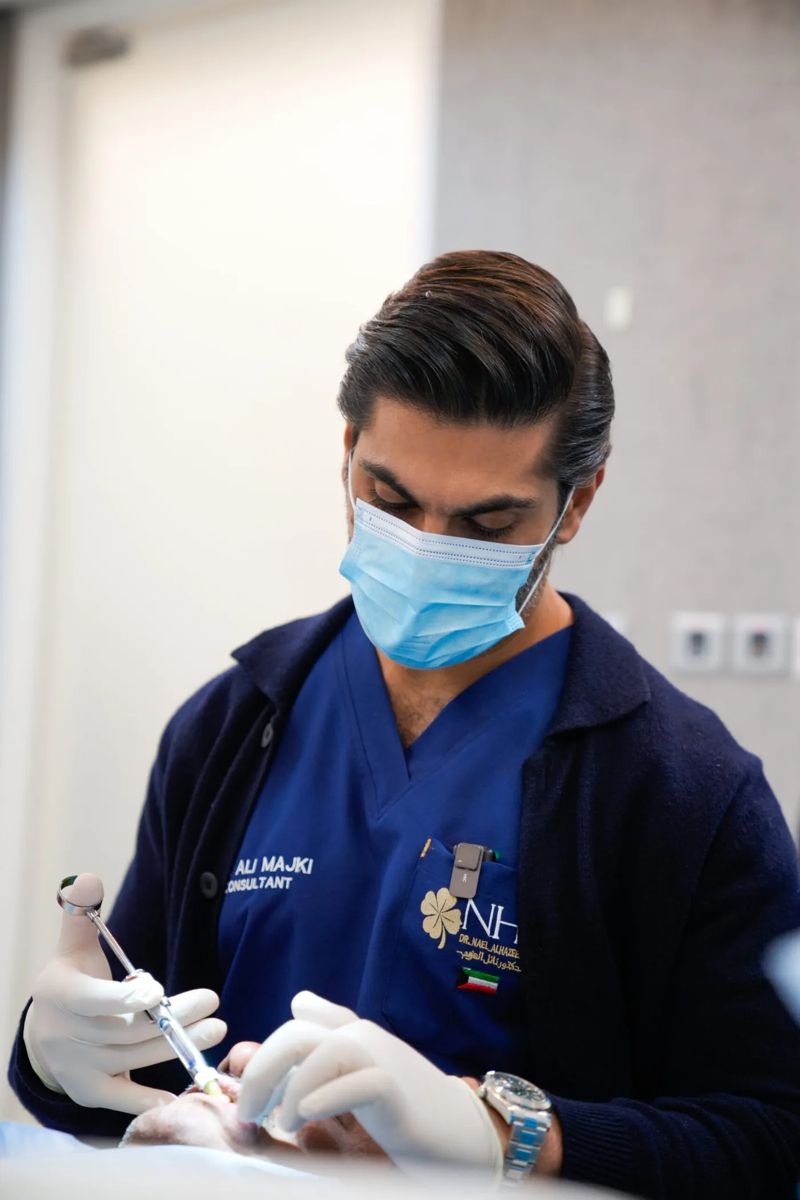
However it is typed into a search box, whether holywood smile or holly wood smile, the questions are the same. At Aline Dental in Shaab, Dr. Ali Majki shows patients the design and a trial version before any preparation, so the decision rests on something they have actually seen.
Scientific sources
Morimoto S., Albanesi R.B., Sesma N., Agra C.M., Braga M.M. Main clinical outcomes of feldspathic porcelain and glass-ceramic laminate veneers: a systematic review and meta-analysis of survival and complication rates. International Journal of Prosthodontics, 2016;29(1):38-49. doi:10.11607/ijp.4315
Beier U.S., Kapferer I., Burtscher D., Dumfahrt H. Clinical performance of porcelain laminate veneers for up to 20 years. International Journal of Prosthodontics, 2012;25(1):79-85. PMID 22259802
Gurel G., Sesma N., Calamita M.A., Coachman C., Morimoto S. Influence of enamel preservation on failure rates of porcelain laminate veneers. International Journal of Periodontics and Restorative Dentistry, 2013;33(1):31-39. doi:10.11607/prd.1488
Edelhoff D., Sorensen J.A. Tooth structure removal associated with various preparation designs for anterior teeth. Journal of Prosthetic Dentistry, 2002;87(5):503-509. doi:10.1067/mpr.2002.124094
Frequently asked questions
What are the main disadvantages of a Hollywood smile? Three: enamel that is removed does not come back, the veneers will need replacing after some years, and upkeep is permanent, including a night guard for people who grind. All three are reduced by conservative preparation and careful design.
How long does a Hollywood smile last? Studies estimate porcelain veneer survival at about 93.5% at ten years and about 83% at twenty; grinding, smoking and poor cleaning shorten it.
Can I go back to my natural teeth afterwards? Not if enamel has been removed; the tooth will always need a veneer. That is why a trial stage before preparation matters.
Do veneers cause gum problems or bad breath? Veneers with accurate margins that are cleaned well do not. Bulky or overhanging edges trap plaque and inflame the gum, which is a fault of execution, not of veneers as such.
Where can I have a Hollywood smile in Kuwait? Dr. Ali Majki sees patients at Aline Dental in Shaab, Kuwait; patients come to him from across Kuwait — from Jahra to Al-Rai and The Avenues — and from Doha and Qatar.