How do you choose a dentist for crowns?
A good crown lasts for years because of how well it is made and fitted, not because of a brand name. When you look for a dentist for crowns Kuwait wide, judge the margins, the dental lab, the bite check and the follow-up, which are the technical details that decide whether a crown stays sealed and comfortable. Price on its own tells you nothing about any of them.
Start with the margin
The margin is the join between the crown and the tooth. A precise margin keeps plaque and bacteria out; a gap lets them in. A narrative review of fixed restorations and gum health (Srimaneepong et al., 2022) describes how a poor margin fit leads to plaque build-up, recurrent decay at the edge and inflamed gums, while a well-fitting margin placed at or just above the gum line is far easier to keep clean.
So when you compare work, ask to see close-up photos of finished crowns where the margin meets the gum. A tidy, almost invisible join is the single clearest sign of careful preparation and a well-made crown.
Ask about the dental lab and materials
A crown is designed by the dentist but usually built by a dental technician in a laboratory. A dentist who works with a reliable lab, takes accurate impressions or a digital scan, and can explain why a particular ceramic was chosen is giving you more useful information than any price list. The common choices are zirconia for strength and E.max (lithium disilicate) for front-tooth appearance.
The try-in: never skip it
Before a crown is cemented for good, it should be tried in so the dentist can check the shade against the neighbouring teeth, the contact points with the teeth beside it, and how it sits against the gum. This is also your chance to see it. A dentist who rushes straight to final cementing without a proper try-in is skipping an important safeguard.
What the bite check tells you
A crown that is even slightly too high changes how your teeth meet and can cause aching or a cracked crown later. The dentist should adjust the bite with marking paper until it feels even, and should ask whether you grind your teeth. If you do, a night guard protects the new crown. Attention to the bite separates careful work from quick work.
Does the crown material match your tooth?
When patients compare dental crowns Kuwait options, they often ask which ceramic is best, but the honest answer is that it depends on the tooth: E.max for a front tooth where looks matter most, zirconia for a molar or a heavy bite. A dentist who offers the full range of crowns and bridges Kuwait patients need will match the material to the tooth rather than fitting the same thing to everyone.
A large systematic review of single crowns (Sailer et al., 2015) found five-year survival of about 96.6% for reinforced glass-ceramic crowns such as E.max and 94.7% for metal-ceramic crowns. Both are high, which tells you that the fit and the dentist matter more than the material label.

Follow-up and aftercare
The work is not finished when the crown is cemented. A good dentist reviews the crown, checks the margin and the gum, and sees you for regular cleanings every six months. Ask whether follow-up is part of the plan. A crown that is never reviewed can develop decay at the margin unnoticed.
A note on experience
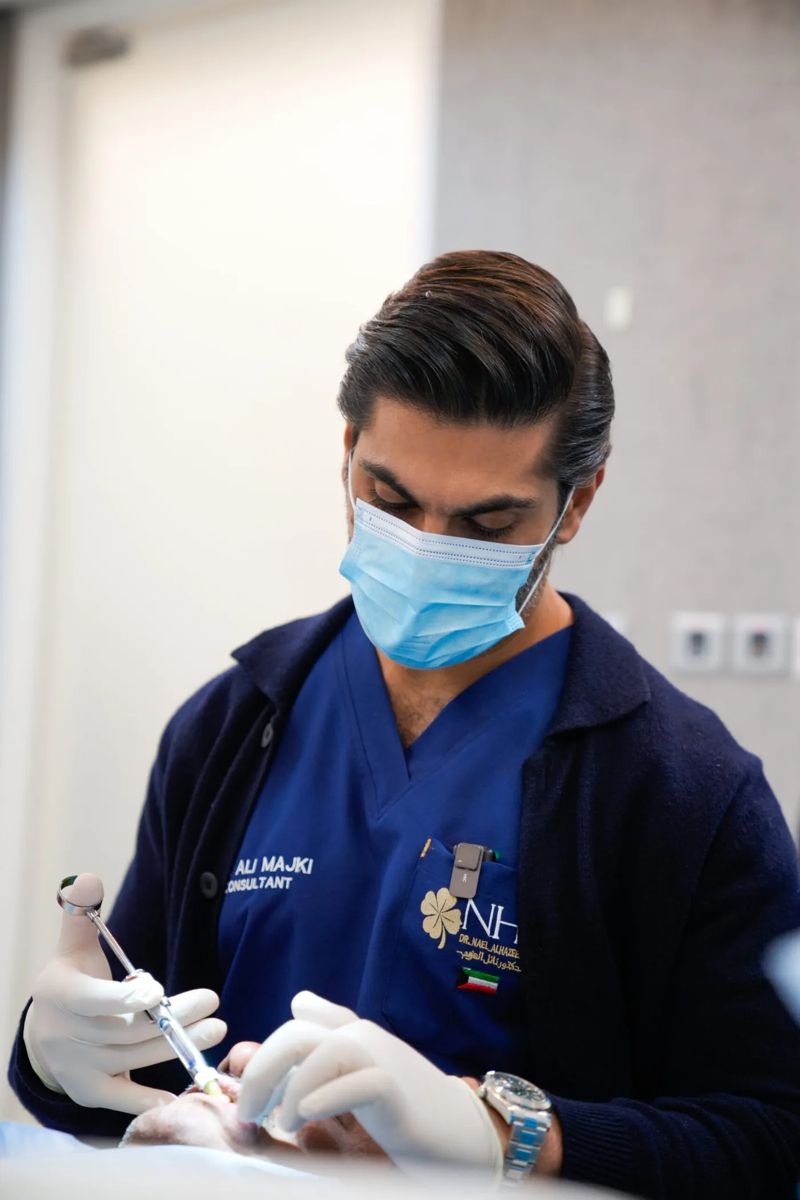
Dr. Ali Majki is a consultant in comprehensive and cosmetic dentistry with more than twenty years in restorative work, and plans crowns from an examination, X-rays and a digital design rather than a fixed menu. Whoever you choose, the same checklist applies: margins, lab, try-in, bite and follow-up.
Scientific sources
Srimaneepong V. et al. Fixed Prosthetic Restorations and Periodontal Health: A Narrative Review. Journal of Functional Biomaterials, 2022. doi:10.3390/jfb13010015
Sailer I. et al. All-ceramic or metal-ceramic tooth-supported fixed dental prostheses? Part I: Single crowns. Dental Materials, 2015. doi:10.1016/j.dental.2015.02.011
Frequently asked questions
How do I know if a crown fits well? A well-fitting crown feels smooth where it meets the gum, does not shred floss when you clean the edge, and does not feel high when you bite; your dentist should confirm the margin and the bite before final cementing.
Is a more expensive crown always better? No. Quality comes from an accurate margin, a good lab and a careful bite check, not from price; a costly crown with a poor margin will still fail early.
How long should dental crowns last? With accurate fit, good hygiene and regular reviews, crowns commonly serve many years; grinding, decay at the margin and skipped check-ups are what shorten their life.
Can any dentist place crowns and bridges? Many general dentists do; what matters is their attention to margins, materials and follow-up rather than a title.
Should I whiten before getting a crown? Yes. A crown is colour-matched when it is made and does not whiten later, so any whitening should come first.
Where can I find a dentist for crowns in Kuwait? Dr. Ali Majki sees patients at Aline Dental in Shaab, Kuwait; patients come to him from across Kuwait — from Jahra to Al-Rai and The Avenues — and from Doha and Qatar.