What causes receding gums?
Receding gums happen when the gum margin pulls back and exposes part of the tooth root. The most common drivers are forceful tooth brushing, gum disease, tooth grinding and simply having thin gum tissue over the teeth.
Mild gum recession is very common and often needs nothing more than a change of habits. Deeper recession that causes sensitivity, root decay or a defect that keeps enlarging is the kind that needs attention. If you notice your gums receding on one or two teeth, it is worth having them checked before the problem spreads.

Hard brushing and abrasion
Scrubbing hard with a stiff brush can wear the gum down over years, and it often shows on the cheek-side of the canines and premolars. A systematic review (Rajapakse et al., 2007) found the evidence linking tooth brushing to non-inflammatory recession to be inconclusive — brushing is one factor among several, not the sole cause. The practical lesson is a soft brush and a gentle technique rather than force.
Gum disease and inflammation
Periodontitis is the other major cause. When plaque and tartar are left along the gum line, the inflammation destroys the supporting bone and the gum recedes with it, often between several teeth at once. Here the recession is a sign of active gum disease, so controlling the disease comes before anything cosmetic.
Other causes
A tooth that sits outside the arch has thin bone and gum over it and recedes easily. Night-time clenching and grinding load the necks of the teeth. Lip or tongue piercings rub the gum, rapid orthodontic movement can outrun the gum, and some people simply inherit a thin gum type. Usually more than one of these acts together.
When do receding gums need treatment?
Gum recession treatment is considered when the exposed root is sensitive to cold or brushing, when the root surface starts to decay, when the defect is clearly getting bigger over time, when it affects appearance at the front, or when the shape makes a tooth hard to keep clean. Many cases outside these situations are simply monitored.
How receding gums are treated
The first step is always to remove the cause: correcting a harsh brushing habit, treating gum disease with professional cleaning, or fitting a night guard for grinders. For sensitivity, desensitising toothpaste and sealing the exposed root help.
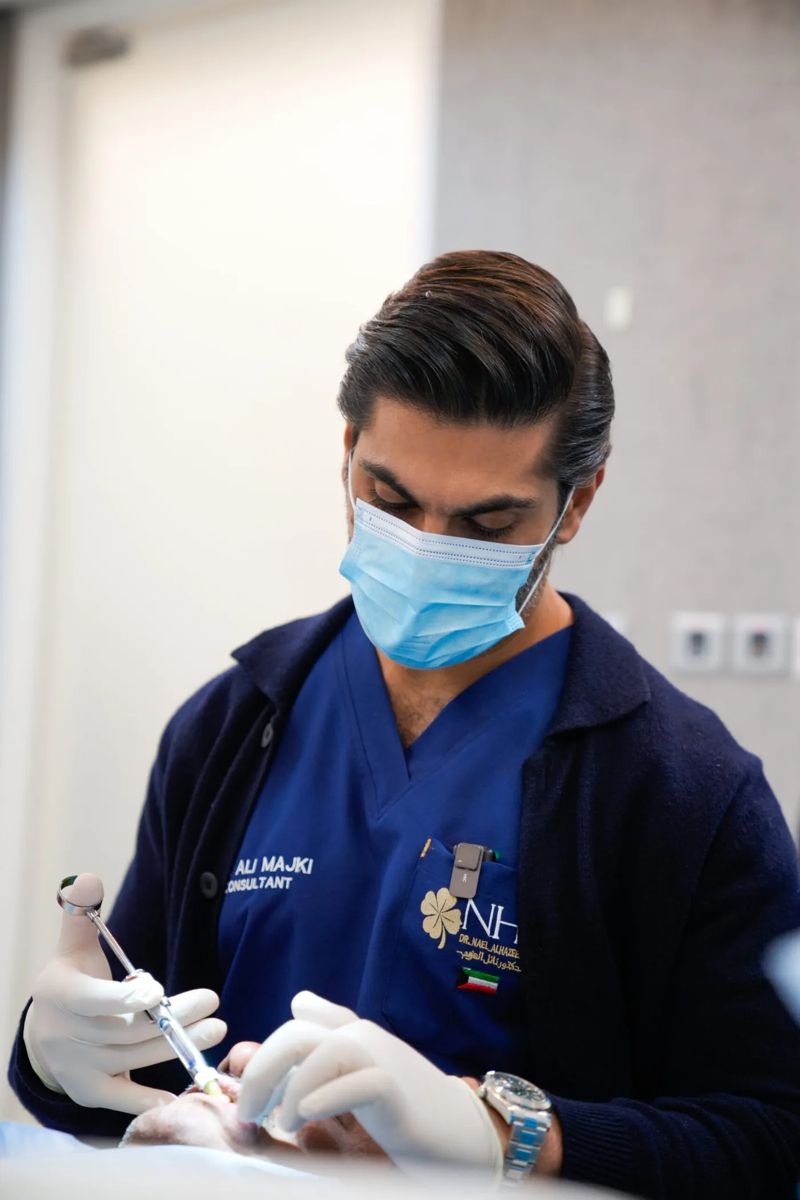
For an established defect, root coverage is done by gum surgery with a soft-tissue graft. A systematic review from the American Academy of Periodontology (Chambrone & Tatakis, 2015) found that connective tissue graft procedures give the best and most predictable root coverage. This grafting is performed by a specialist; Dr. Ali Majki assesses the recession, manages the causes and the restorative side, and refers the surgical graft to the specialist.
Preventing further recession
Switch to a soft brush and a gentle, angled technique instead of sawing back and forth. Keep the gums healthy with daily cleaning between the teeth and regular professional cleaning. Treat grinding, avoid lip and tongue jewellery, and do not smoke. Stopping the cause is what stops the recession, whether or not surgery is ever needed.
Scientific sources
Rajapakse P.S. et al. Does tooth brushing influence the development and progression of non-inflammatory gingival recession? A systematic review. Journal of Clinical Periodontology, 2007. doi:10.1111/j.1600-051X.2007.01149.x
Chambrone L., Tatakis D.N. Periodontal soft tissue root coverage procedures: a systematic review from the AAP Regeneration Workshop. Journal of Periodontology, 2015. doi:10.1902/jop.2015.130674
Frequently asked questions
Can receding gums grow back on their own? No, gum that has receded does not regrow by itself; the aim is to stop it worsening, and surgery can cover some defects.
Is gum recession serious? Mild recession is common and harmless; it matters when it causes sensitivity, root decay or keeps progressing.
Why are my gums receding at a young age? Usually from hard brushing, thin gum tissue, grinding or orthodontic movement rather than age itself.
Does scaling cause gum recession? Professional scaling does not cause recession; it treats the gum disease that does. Any sensitivity after a cleaning is usually temporary.
Do I always need gum surgery for recession? No, many cases are managed by correcting the cause; surgery is reserved for specific defects and is done by a specialist.
Where can I get receding gums assessed in Kuwait? Dr. Ali Majki sees patients at Aline Dental in Shaab, Kuwait; patients come to him from across Kuwait — from Jahra to Al-Rai and The Avenues — and from Doha and Qatar.