Why have my teeth shifted after braces?
Teeth shifting after braces is extremely common and usually comes down to one thing: retainers were not worn long enough. Teeth have a natural tendency to drift back toward their old positions, a process called orthodontic relapse, and only consistent retention holds them. If your teeth moved after braces years ago, the good news is that minor relapse can often be corrected with a short course of treatment.
Why does relapse happen?
After braces come off, the fibres and bone around each tooth are still settling, and the lips, tongue and bite keep pushing on the teeth for life. A Cochrane review of retention found that without some form of retainer, teeth tend to relapse — there is no age at which they become permanently stable. This is normal biology, not a failure of the original treatment.
The role of retainers
Retainers are what keep the result. The same Cochrane review, drawing on dozens of trials and thousands of participants, found both fixed retainers (a thin wire bonded behind the teeth) and removable retainers are used successfully, with no single method proven clearly superior. The certainty of the evidence was low, which is why the practical advice is simply to wear whatever retainer you are given, as instructed, for the long term.
Types of retainer
A bonded wire sits permanently behind the front teeth and is invisible from the front. A clear removable retainer looks like a thin aligner and is worn mostly at night. Some people have both. Each has trade-offs: fixed wires need careful cleaning and can break, while removable ones only work if you actually wear them.
Short aligner retreatment
When only a few front teeth have drifted, a full course of braces a second time is rarely needed. A short run of clear aligners can often nudge the teeth back. A systematic review of clear aligner therapy found low-to-moderate certainty that aligners give clinically acceptable results in mild-to-moderate cases, which describes most relapse. Clear aligners — searched by some as invisalign after braces, or typed invisaline — are well suited to this kind of limited correction, though more complex relapse may still need fixed braces.
Preventing it a second time
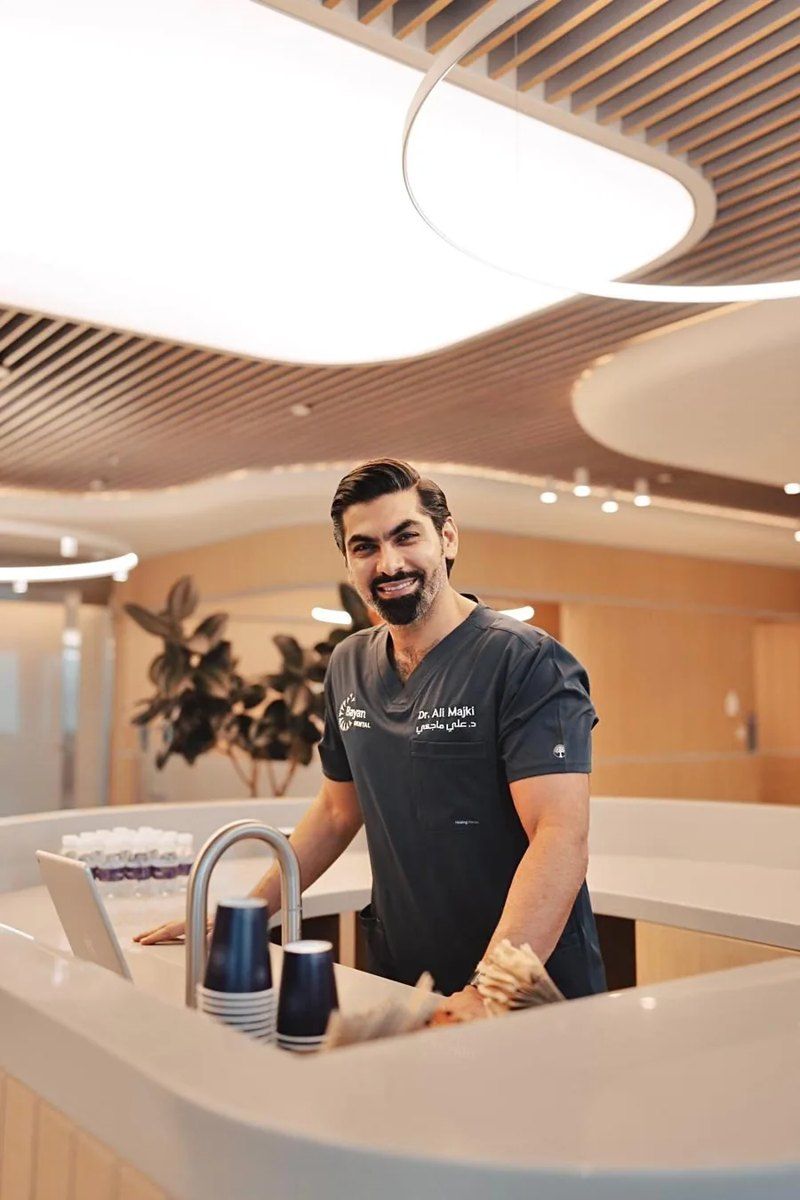
If you are considering a second time braces or aligner course, plan the retention from the start: know which retainer you will wear and commit to it. A night-time removable retainer or a bonded wire, checked periodically, is what protects the result. Dr. Ali Majki assesses relapse cases at Aline Dental in Shaab and refers more complex movements to a specialist, so you know whether a short aligner course is enough or whether fixed braces are needed.
Scientific sources
Martin C., Littlewood S.J., Millett D.T., Doubleday B., Bearn D., Worthington H.V., Limones A. Retention procedures for stabilising tooth position after treatment with orthodontic braces. Cochrane Database of Systematic Reviews, 2023. doi:10.1002/14651858.CD002283.pub5
Robertson L., Kaur H., Fagundes N.C.F., Romanyk D., Major P., Flores-Mir C. Effectiveness of clear aligner therapy for orthodontic treatment: a systematic review. Orthodontics & Craniofacial Research, 2020. doi:10.1111/ocr.12353
Frequently asked questions
Can teeth really move years after braces? Yes — teeth can drift at any age, which is why retention is considered lifelong rather than temporary.
Do I need full braces again if my teeth shifted after braces? Often not; mild relapse can usually be corrected with a short clear aligner course rather than a second full fixed treatment.
How long should I wear a retainer? Indefinitely, at least at night, because the tendency to relapse does not disappear with time.
Is invisalign after braces a good option for relapse? For mild-to-moderate drifting it is often ideal, while severe relapse may still need fixed braces.
Will a bonded wire stop my teeth moving? It holds the front teeth well as long as it stays intact, but it still needs checking and good cleaning.
Where can I fix teeth that shifted after braces in Kuwait? Dr. Ali Majki sees patients at Aline Dental in Shaab, Kuwait; patients come to him from across Kuwait — from Jahra to Al-Rai and The Avenues — and from Doha and Qatar.