What is conservative dentistry?
Conservative dentistry is the branch of dentistry concerned with keeping the natural tooth: preventing decay, detecting it early and repairing damage with the least possible removal of sound tooth tissue. Many dental schools call the same field restorative dentistry or operative dentistry; the newer term minimally invasive dentistry describes its guiding principle.
The idea behind it is simple. Tooth that has been drilled away does not grow back, so every millimetre preserved today extends the life of the tooth later. Conservative treatment therefore does not start with the drill. It starts with a question: what is the smallest intervention that solves this problem?

Why “conservative”? The restorative cycle
Every filling has a lifespan. When it is replaced the cavity becomes a little larger; after several replacements the tooth needs a crown, and later perhaps root canal treatment. Dentists call this path the restorative cycle. The consensus recommendations of the International Caries Consensus Collaboration (Schwendicke et al., 2016) are direct about it: entering the restorative cycle should be avoided as far as possible, and when a tooth does enter, the aim is to delay and slow the cycle.
That is where the ladder comes from. Treatment begins on the lowest rung that is sufficient and climbs only when the tooth really needs it.
Rung one: stopping decay before it becomes a cavity
Early decay is a chalky white spot, not a hole. At this stage it can be halted, and sometimes reversed, without any drilling. The FDI World Dental Federation task group report on minimal intervention dentistry (Frencken et al., 2012) singles out two behaviours: keeping the intake of fermentable sugars to no more than five times a day, and cleaning all tooth surfaces twice a day with a fluoride toothpaste.
In the clinic this is supported by a caries risk assessment, fluoride varnish on vulnerable surfaces, and monitoring of early spots with examinations and X-rays rather than rushing to fill them.
Rung two: sealing and infiltrating instead of drilling
The deep grooves of molars are a favourite site for decay. A fissure sealant is a thin resin layer that closes the groove without any cutting. A Cochrane review of 38 trials (Ahovuo-Saloranta et al., 2017) found that resin sealants on permanent molars in children and adolescents clearly reduce decay: if 40% of unsealed surfaces were expected to decay within two years, sealing would bring that down to about 6%.
For early lesions between teeth and on smooth surfaces there is resin infiltration, in which a very fluid resin soaks into the pores of the spot and blocks them. The FDI report describes it as a promising therapy for preventing non-cavitated lesions from progressing.
Rung three: small, adhesive fillings
Once there is a cavity that cannot be kept clean or sealed, a filling is indicated. Modern tooth restoration treatment differs from the fillings of the past: the cavity is no longer enlarged to lock the filling in, because tooth-coloured composite bonds to the tooth. Only the decayed tissue is removed and the sound tooth is left alone.
Even deep decay has a conservative rule. The consensus recommendations state that carious tissue close to the pulp does not have to be removed completely; the priority is to keep the pulp healthy under a well-sealed restoration. And when an old filling is defective in one area, repairing it is preferable to replacing it wherever possible, because each replacement costs tooth.
Rung four: inlays and onlays before a crown
When the damage is too large for a filling but does not justify a full crown, bonded partial restorations take over. An inlay fits inside the tooth; an onlay covers only the weakened cusps. A laboratory measurement study (Edelhoff and Sorensen, 2002) put numbers on the difference: adhesive and inlay preparations removed roughly 5.5% to 27% of the crown of the tooth, while full crown preparations removed 67.5% to 75.6%.
A crown is not the enemy. It is the correct answer when the walls of a tooth can no longer cope. It is simply the last rung of the ladder, not the first.
When do you need conservative treatment?
For any decay or suspicious spot; an old filling with stained or broken margins; a cracked tooth or a lost corner; enamel wear from acid or grinding; sensitivity at the necks of the teeth; and before cosmetic treatment, so that it is built on a sound foundation.
It has limits. If inflammation has reached the pulp, the treatment becomes root canal treatment, and if a tooth cannot be restored, it has to be replaced. The purpose of conservative care is to keep you away from that point.
How is it applied in the clinic?
It begins with an examination and bitewing X-rays that show the surfaces between the teeth, followed by a decision for each tooth: monitor, seal, fill, or restore with a partial restoration. People looking for conservative dentistry in Kuwait are often simply looking for a dentist who will explain that decision.
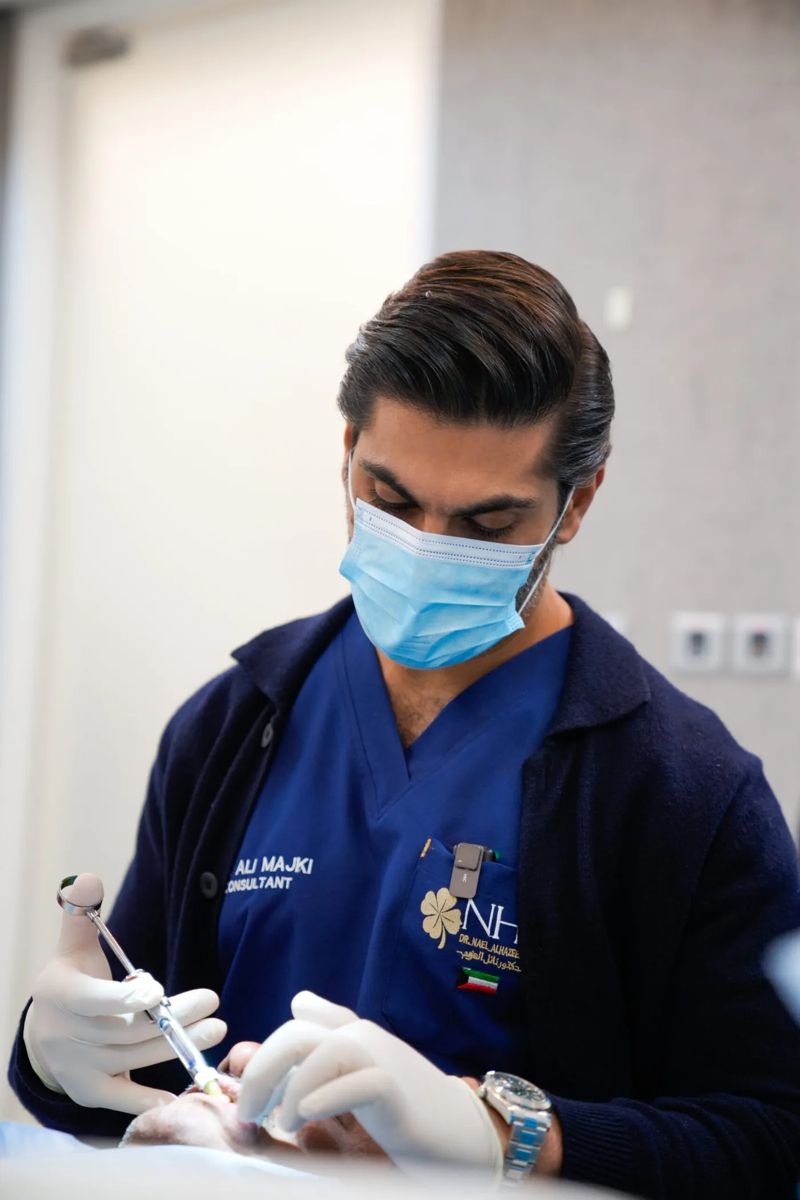
Dr. Ali Majki, Consultant in Comprehensive & Cosmetic Dentistry, works to the rule of the least preparation that gives the protection required, and explains why a given rung was chosen rather than the one above it.
Scientific sources
Frencken J.E., Peters M.C., Manton D.J., Leal S.C., Gordan V.V., Eden E. Minimal intervention dentistry for managing dental caries - a review: report of a FDI task group. International Dental Journal, 2012. doi:10.1111/idj.12007
Schwendicke F., Frencken J.E., Bjørndal L. et al. Managing Carious Lesions: Consensus Recommendations on Carious Tissue Removal. Advances in Dental Research, 2016. doi:10.1177/0022034516639271
Ahovuo-Saloranta A., Forss H., Walsh T., Nordblad A., Mäkelä M., Worthington H.V. Pit and fissure sealants for preventing dental decay in permanent teeth. Cochrane Database of Systematic Reviews, 2017. doi:10.1002/14651858.CD001830.pub5
Edelhoff D., Sorensen J.A. Tooth structure removal associated with various preparation designs for posterior teeth. International Journal of Periodontics & Restorative Dentistry, 2002;22(3):241-9. PMID 12186346
Frequently asked questions
What is the difference between conservative dentistry and endodontics? Conservative dentistry restores the crown of a tooth whose pulp is alive. Endodontics, or root canal treatment, is needed once inflammation or infection has reached the pulp itself.
Does every cavity need a filling? No. Early decay that has not broken the surface can often be halted with fluoride, changes in habits or sealing, and then monitored.
Is conservative dentistry the same as restorative dentistry? In most dental schools, yes: the names overlap. “Conservative” stresses preserving tooth tissue, while “restorative” stresses rebuilding what was lost.
When do I need an onlay instead of a filling? When one or more cusps of a back tooth are weakened and an ordinary filling would not protect them from fracture, but the tooth does not yet need a full crown.
Is minimally invasive dentistry only for children? No. Sealants are best known in children, but the rest of the ladder serves adults just as well.
Where can I find conservative dental treatment in Kuwait? Dr. Ali Majki sees patients at Aline Dental in Shaab, Kuwait; patients come to him from across Kuwait — from Jahra to Al-Rai and The Avenues — and from Doha and Qatar.