In-office or take-home whitening: which works better?
Both work, and they end up in much the same place. A meta-analysis of randomised trials found no significant difference between in-office and dentist-supervised at-home tooth bleaching in either the colour change achieved or the risk and intensity of sensitivity. In-office treatment is faster; take-home trays are gentler in pace and easier to top up. The choice is mostly about time, convenience and how your teeth react.
How does each method work?
Whichever way people spell it when they search, “teeth whiting” or “teeth whitning” included, professional teeth whitening relies on peroxide. Hydrogen peroxide passes through enamel and breaks down the coloured molecules inside the tooth. Carbamide peroxide is a slower-release form: according to the American Dental Association, it releases about one-third of its content as hydrogen peroxide.
In the clinic, a concentrated hydrogen peroxide gel is applied to the teeth for short periods after the gums have been covered with a protective barrier. For home teeth whitening, the dentist makes custom trays from a scan or impression and dispenses a carbamide peroxide gel; the ADA notes that at-home systems typically range from 10% to 38% carbamide peroxide. The trays are worn daily for a period the dentist sets.
What does the evidence say about results?
The comparison above comes from de Geus and colleagues (2016), who pooled randomised trials of the two approaches and detected no difference in whitening effect. They added a fair warning: the trials used different gel strengths, wearing times and numbers of sessions, so the result is an average, not a rule for every protocol.
A Cochrane review of 71 trials of home-based products (Eachempati et al., 2018) confirmed that they whiten teeth compared with placebo, though the certainty of the evidence was low to very low and follow-up was short. It could not identify a best concentration or wearing time.
Is laser teeth whitening better?
What is sold as laser teeth whitening or light-activated whitening is in-office peroxide gel with a lamp or laser shone on it. A meta-analysis of 21 randomised trials (Maran et al., 2018) found that adding light did not improve the colour change and did not alter sensitivity, at either high or low peroxide concentrations. The gel does the whitening; the light is optional.
Which causes more sensitivity?
Temporary sensitivity can follow any form of bleaching. The ADA describes mild to moderate sensitivity in up to two-thirds of users in the early stages, and the Cochrane review found sensitivity and gum irritation to be the most common side effects, more frequent with stronger gels, and mild and transient.
Overall the pooled trials showed no difference in sensitivity between the two methods. For an individual, though, home trays have a practical advantage: you can skip a day, shorten a session or move to a weaker gel, whereas an in-office session delivers its dose at once. Gum irritation usually comes from gel touching the gum, which is why a well-fitting tray or a properly placed barrier matters.
Who should choose which?
In-office whitening suits people with a deadline, those who will not reliably wear trays, and anyone who prefers the whole process to be supervised. Take-home trays suit people with a history of sensitive teeth, those who want gradual control over the final shade, and those who expect to top up after coffee, tea or smoking dull the result. The two are often combined: a clinic session to start, trays to finish and maintain.
What should be checked before whitening?
An examination comes first. Decay, leaking fillings, cracks and exposed roots let peroxide reach the nerve more easily and need to be dealt with beforehand. The ADA also stresses that only natural tooth structure whitens: crowns, veneers and tooth-coloured fillings stay the shade they are, so visible restorations may need replacing afterwards to match.
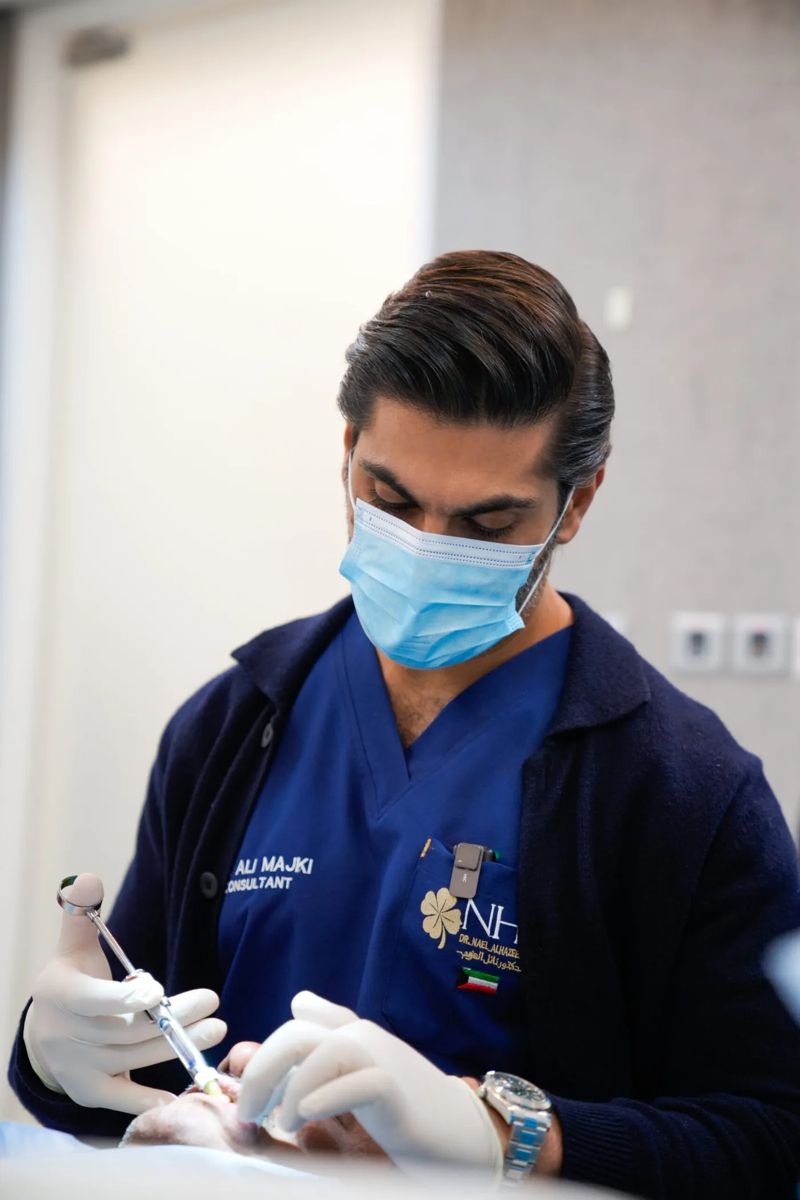
This is why whitening is planned before veneers or crowns rather than after. Dr. Ali Majki records the starting shade at Aline Dental in Shaab and agrees a realistic target with the patient before any gel is applied.
Scientific sources
de Geus J.L., Wambier L.M., Kossatz S., Loguercio A.D., Reis A. At-home vs in-office bleaching: a systematic review and meta-analysis. Operative Dentistry, 2016. doi:10.2341/15-287-LIT
Maran B.M., Burey A., de Paris Matos T., Loguercio A.D., Reis A. In-office dental bleaching with light vs. without light: a systematic review and meta-analysis. Journal of Dentistry, 2018. doi:10.1016/j.jdent.2017.11.007
Eachempati P. et al. Home-based chemically-induced whitening (bleaching) of teeth in adults. Cochrane Database of Systematic Reviews, 2018. doi:10.1002/14651858.CD006202.pub2
American Dental Association. Whitening (Oral Health Topics). ada.org (accessed November 2026).
Frequently asked questions
Is in-office whitening stronger than take-home whitening? The gel is more concentrated and the result arrives sooner, but trials found the final shade change to be similar.
Does teeth whitening damage enamel? Used as directed under dental supervision, peroxide whitening is considered safe; the usual side effects are temporary sensitivity and gum irritation.
How long does teeth whitening last? It varies from person to person and fades faster with coffee, tea and smoking; trays make periodic top-ups straightforward.
Can I whiten crowns or veneers? No. Restorations do not respond to peroxide, so shade planning has to account for them.
Is whitening safe for sensitive teeth? Usually, with a lower-strength gel, shorter sessions and a desensitising toothpaste beforehand, after the cause of the sensitivity has been checked.
Where can I have supervised teeth whitening in Kuwait? Dr. Ali Majki sees patients at Aline Dental in Shaab, Kuwait; patients come to him from across Kuwait — from Jahra to Al-Rai and The Avenues — and from Doha and Qatar.